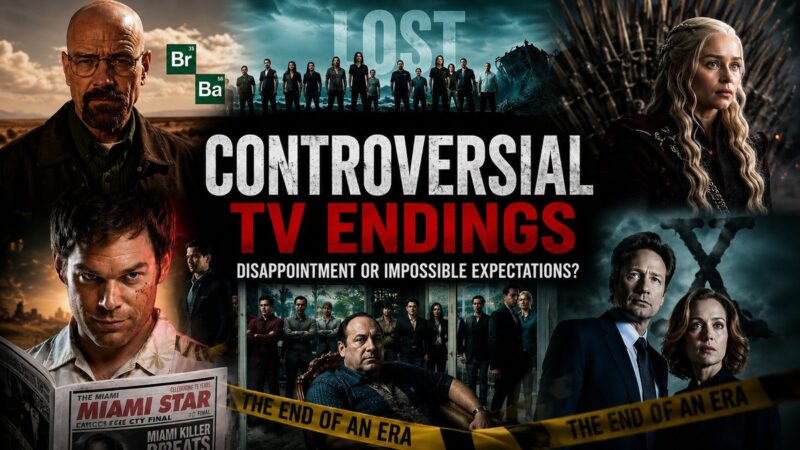
Were They Really That Bad? Television’s Most Controversial Series Finales
When the Problem Isn’t the Ending, but the Expectations
Television history is filled with a recurring pattern. A show can spend years building a loyal audience, receive critical acclaim, dominate cultural conversations, and become one of the most beloved productions of its generation. Then the finale arrives, and suddenly part of the audience feels disappointed. Social media explodes, rankings of the worst endings ever begin to circulate, and the narrative quickly shifts from celebrating the journey to criticizing the destination.
The reality, however, is often far more complicated. Many controversial finales are not necessarily bad episodes. More often, they are victims of expectations that became impossible to satisfy. The bigger the phenomenon, the harder it becomes to deliver a conclusion that feels perfect for everyone. Looking back at some of television’s most debated endings reveals an interesting truth: many of them may have been judged more harshly because of what audiences expected than because of what they actually delivered.
📊 Quick View
🎬 Concept: Analyzing television finales that generated significant audience backlash.
🧠 Focus: Comparing public perception with long-term critical and audience reception.
⚡ Approach: Editorial analysis without spoilers.
⭐ Level: Some of the most influential television series ever produced.
🧩 Context: Many controversial endings belong to universally acclaimed shows.
Breaking Bad and the Difficulty of Surpassing Perfection
Few entries on lists of disappointing finales are more surprising than Breaking Bad. Widely regarded as one of the greatest television dramas ever created, the series maintained an extraordinary level of quality throughout its entire run. Even its lowest-rated episodes would be considered exceptional by the standards of most productions.
Perhaps that is precisely why some viewers expected even more from its conclusion. When a show consistently operates at such a high level, audiences begin to imagine a finale that will somehow exceed perfection itself. That is an almost impossible task. Looking back today, it is difficult to understand why the ending continues to appear on certain controversial lists. Rather than being a failure, it feels like a victim of impossible expectations created by years of excellence.
Lost and the Burden of Cultural Phenomenon Status
If there is one series that perfectly embodies the idea of a divisive ending, it is Lost. Few television shows have generated so many theories, discussions, and fan debates. Week after week, viewers dissected every detail, searching for clues and answers to increasingly complex mysteries.
The challenge with a phenomenon like Lost is that audiences become emotionally invested not only in the characters but also in their own theories. No matter how the story concluded, some viewers were always going to feel dissatisfied. Interestingly, despite its reputation as one of television’s most controversial finales, the final episode itself remains highly rated by many viewers. That contrast suggests that the public narrative surrounding the ending may be far more negative than the actual reception among those who watched it.
When the Decline Begins Before the Finale: True Blood and The X-Files
Not every controversial ending is the result of a single disappointing episode. In some cases, the problems begin several seasons earlier, and the finale simply becomes the symbol of a longer decline.
True Blood is a clear example. The early seasons successfully combined supernatural elements, drama, and entertainment into a compelling package. Over time, however, the series struggled to maintain the same level of consistency. By the time it reached its conclusion, many viewers were already feeling disconnected from what had once made the show special. The ending itself became the final chapter in a decline that had been unfolding for years.
The X-Files presents a different case. The series was never entirely consistent, alternating between brilliant episodes and less memorable ones throughout its long run. Its biggest challenge was longevity. Extending a story over eleven seasons inevitably creates fatigue, and maintaining the same level of mystery and excitement becomes increasingly difficult. In that context, criticism of its ending often reflects broader concerns about how long the series continued rather than the finale alone.
The Sopranos and the Art of Leaving a Conversation Open
Another frequent appearance on lists of controversial finales is The Sopranos. This is particularly fascinating because the series remains one of the most celebrated dramas in television history. It consistently appears near the top of rankings that attempt to identify the greatest shows ever made.
Its ending continues to spark debate decades later, which may actually be part of its success. Rather than providing a conventional farewell, it challenged audiences and encouraged discussion long after the credits rolled. Whether viewers loved it or hated it, they continued talking about it. That level of cultural impact is difficult to achieve and suggests that the finale accomplished something more significant than simply providing closure.
Dexter and Game of Thrones: When the Criticism Feels Justified
There are, of course, examples where criticism appears much easier to understand. Dexter is one of them. For years, the series thrived thanks to an unforgettable central character and a formula that remained engaging despite its repetitive nature. Yet its final season struggled to maintain the same narrative quality, leaving many fans frustrated with the direction the story ultimately took.
Game of Thrones experienced a similar fate, though on an even larger scale. For much of its run, it was arguably the defining television event of its era. It united critics and audiences in a way few productions ever have. That is precisely why the reaction to its final season felt so dramatic. The decline in audience ratings for its concluding episodes became impossible to ignore, turning the show into perhaps the most famous example of a finale failing to meet overwhelming expectations.
The 100 and the Danger of Staying Too Long
One of television’s greatest challenges is knowing when to stop. The 100 demonstrated remarkable resilience throughout its run, reinventing itself multiple times and surviving major shifts in tone and direction.
However, the series also highlights the risks of extending a story beyond its natural endpoint. As seasons continue to accumulate, maintaining narrative momentum becomes increasingly difficult. Audiences often remember the final impression more vividly than the years of quality that came before it. In the case of The 100, many criticisms of the ending reflect broader concerns about whether the series had already told its best stories long before it reached its conclusion.
The Real Enemy of Great Endings
After examining some of television’s most debated finales, one conclusion becomes clear. In many cases, the ending itself is not the true problem. The challenge lies in the emotional connection audiences develop with great shows. Viewers spend years investing in characters, constructing theories, and imagining ideal outcomes. By the time the finale arrives, the expectations can become impossible to satisfy.
That does not mean every controversial ending deserves a defense. Some finales genuinely fail to deliver on the promise of what came before. Yet many others suffer from the simple reality that saying goodbye is extraordinarily difficult. The greatest television series create such strong emotional bonds that no ending could ever feel completely satisfying.
Perhaps that is why so many of the most criticized finales belong to some of the most celebrated shows in television history. The bigger the legacy, the harder the farewell.
For a broader look at why long-running shows struggle to land a satisfying finale, see our analysis of when a TV series should end.
For more on the shows behind these debates, explore why The 100 struggled with its ending, The Sopranos and its television legacy, and the storytelling of Breaking Bad.
Few television finales have inspired as much discussion as Game of Thrones. You can revisit our assessment of the series’ wider legacy.
This editorial is also available in Spanish, in our analysis of controversial television endings.