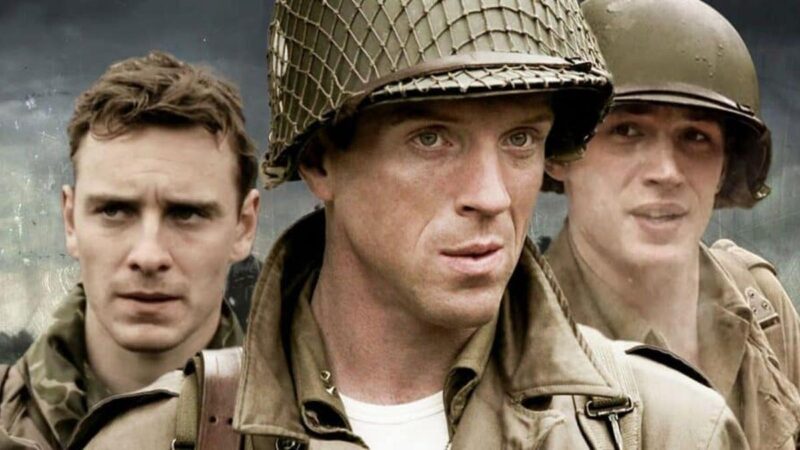
Band of Brothers: Why Its Human Story Still Sets the Standard
Band of Brothers (Hermanos de sangre in Spain) is one of those miniseries that I don’t merely remember watching — I remember feeling as though I had lived alongside its characters for a while. More than twenty years after its premiere, I still regard it as a benchmark for war storytelling, not because it shows the largest battles, but because it makes the human cost of every battle matter.
The series isn’t interested in treating war as a parade of perfect heroes. Its most powerful moments often come from exhaustion, silence, uncertainty and the relationships that allow people to keep going when everything around them is collapsing.
How Spielberg and Hanks helped change television
After Saving Private Ryan, Steven Spielberg and Tom Hanks continued exploring the Second World War in a different format. HBO’s 2001 miniseries gave them room for a broader, more sustained portrayal of soldiers whose experiences could not be captured in one feature film.
For me, that ambition mattered as much as the impressive scale. Television had not always been associated with this degree of cinematic production, detailed atmosphere or serious dramatic attention. Band of Brothers helped demonstrate what a long-form historical drama could achieve.
Easy Company: the strength of the ensemble
Rather than making one person the unquestioned centre of every scene, the series follows Easy Company as a group that changes over time. People respond differently to danger; relationships evolve under pressure; losses shape what happens next.
I found that ensemble approach particularly affecting. The soldiers never become simply a collection of uniforms waiting for the next battle. We come to recognise their fears, habits, disagreements and friendships. The unit starts to feel like a living community, not just a convenient way to move the plot forward.
Immersion without glorification
The photography, sound and direction do an extraordinary job of making the experience immediate. Yet the series rarely needs to tell us how extraordinary it is. A tense pause, a small decision or a moment of uncertainty can carry more emotional weight than a vast battlefield scene.
That restraint is what I admire most. The production understands the visual power of warfare while refusing to turn it into uncomplicated spectacle. I have seen more recent series with impressive digital effects that still struggle to create the same sense of fear, cohesion and human vulnerability.
Episodes that stay with you
Certain chapters are memorable for the intensity of their action; others stay in my mind for the way they convey fatigue or the burden of living through something nobody should have to endure. The series doesn’t always underline its emotions with a speech or a dramatic flourish.
This is a work that trusts the audience to notice what people do when they have nothing useful left to say. That confidence is part of why I find it so moving on a rewatch.
Why it still feels contemporary
A production from 2001 could easily have begun to seem dated, especially in its more technically ambitious sequences. To me, Band of Brothers has aged exceptionally well. The care taken with its setting and the consistency of its tone give it a solidity that doesn’t depend on contemporary trends.
It also helped establish a model for later high-profile television dramas. Productions such as The Pacific are easier to understand in the context of the expectations this miniseries helped create, even though each has its own focus and identity.
Final verdict: one of the essential war miniseries
I absolutely recommend Band of Brothers, including to viewers who usually find war stories difficult. It requires attention and isn’t something I would casually put on in the background, but its reward is a rare sense of closeness to the people at the heart of the story.
Its lasting achievement is not to make war look glorious; it is to show why the experiences of ordinary people within it deserve to be remembered. Few miniseries have united scale, craftsmanship and emotional depth so convincingly for me.
You can read my longer original Spanish analysis of Hermanos de sangre for more on its human perspective and lasting influence.
For another HBO miniseries that puts ordinary people under extraordinary pressure, explore our review of The Night Of. You can also browse our wider selection of defining 21st-century films and television.