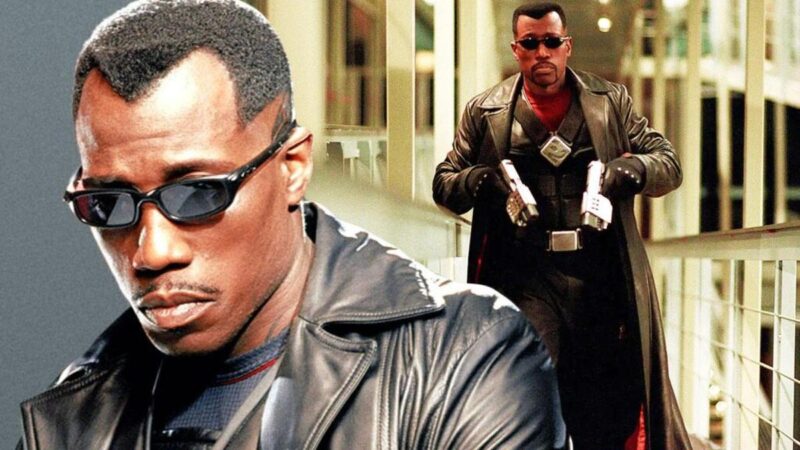
How Blade Helped Save Marvel Before Iron Man and the MCU
When Marvel Was on the Brink of Collapse
By the late 1990s, Marvel was nothing like the powerhouse we know today. It was a company on the verge of collapse. After the comic book speculation boom of the early ’90s burst, the entire market followed, and Marvel filed for bankruptcy in 1996. Its stock, which had once traded around $30–$35 earlier in the decade, crashed to nearly $2. This wasn’t just a downturn—it was a full-scale crisis of confidence, business, and identity.
Comic shops stopped backing Marvel with the same intensity, multiple publishing lines were shut down, and the company was left scrambling to survive. In that process, it sold off its most valuable assets: the rights to its characters. That’s how Spider-Man, the X-Men, and the Fantastic Four ended up in the hands of different studios. Marvel was still alive—but with less control over its future and very limited ability to shape its own cinematic vision.
📊 Quick View
🎬 Concept: The film that changed Marvel’s destiny
🧠 Focus: From bankruptcy to cinematic viability
⚡ Approach: Industry shift through unexpected success
⭐ Level: Foundational turning point
🧩 Context: Blade (1998) as the first modern breakthrough
Marvel Entertainment Was Not Marvel Studios—and That’s Where the Confusion Begins
This is where things usually get misunderstood. Marvel Entertainment existed long before Marvel Studios. It was the corporate structure responsible for comics, licensing, toys, animation, and various brand extensions. In other words, Marvel was already in the entertainment business—but it didn’t yet control a cinematic machine of its own.
There had been shows, smaller projects, adaptations, and partnerships, but nothing resembling a unified division with the ambition to build a shared universe on screen. Marvel Studios would come later as a natural evolution of that need. First came survival—leveraging characters however possible. Then came the realization that the audiovisual side needed structure and strategic importance.
That’s why calling Blade the first Marvel movie needs context. It wasn’t the first adaptation, but it was the first modern success that proved Marvel properties could work in theaters with real commercial strength.
Blade: A Minor Character That Became a Turning Point
In 1998, Blade arrived starring Wesley Snipes, and it did so without the commercial weight of Marvel’s biggest names. It wasn’t Spider-Man, it wasn’t Hulk, and it wasn’t a mainstream icon. For much of the audience, it was almost unknown. That’s exactly why its success mattered so much.
The film didn’t dominate the box office in the way modern blockbusters do, but it performed exceptionally well for its context, budget, and source material. It grossed around $131 million worldwide and, more importantly, delivered something far more valuable than money: proof of concept.
Blade showed that a Marvel-based film didn’t need its most famous hero to connect with audiences. It could have its own tone, identity, violence, and style. It didn’t feel like the beginning of a cinematic empire—but in hindsight, it was the first step toward one.
Avi Arad and the Shift from Survival to Strategy
During that period, Avi Arad played a crucial role. Coming from the toy business, he understood how to turn characters into long-term brands. Marvel had spent too long operating in survival mode—making deals just to stay afloat without building a long-term strategy.
Arad helped push the idea that Marvel couldn’t keep selling pieces of its universe while other studios reaped the real rewards on screen. The philosophy was simple: don’t just sell your characters to Hollywood—become Hollywood.
That shift didn’t happen overnight. There were intermediate steps, evolving structures, and a long corporate journey before Marvel Studios became what we know today. But the mindset changed: stop reacting, start building.
From Blade to X-Men and Spider-Man
After Blade, came X-Men in 2000 and Spider-Man in 2002. At that point, there was no longer any doubt—Marvel’s material worked on the big screen. The problem was clear: most of that success belonged to external studios because the rights were already distributed.
Marvel was watching its characters become global hits while lacking full control of the business behind them. That’s why Blade matters so much—not because it built the empire alone, but because it changed the way Marvel saw itself.
Without that early success, without proof that even a lesser-known character could succeed, everything that followed would have been much harder. It marked the moment Marvel stopped thinking like a struggling publisher and started imagining itself as a future entertainment powerhouse.
The 2005 Gamble That Changed Everything
The real turning point came in 2005, when Marvel decided to finance its own films through a bold and risky move. The company secured a $525 million loan backed by a package of characters it still controlled. This is where the Marvel Studios model truly begins.
From that point on, Marvel wasn’t just licensing properties—it was producing its own films with a clear strategy and a long-term vision. It also explains why there’s still confusion between Marvel and Marvel Studios today. They were part of the same ecosystem, but not identical entities.
Over time, Marvel Studios gained power, identity, and creative control, eventually becoming the central engine of the brand’s cinematic success.
Iron Man: The Definitive Breakthrough
If Blade was the spark, Iron Man was the foundation. Released in 2008, it arrived with uncertainty. Tony Stark wasn’t a top-tier character for general audiences, and Robert Downey Jr. wasn’t seen as a safe leading star at the time.
But everything worked. The film became a massive success, grossing over $580 million worldwide, and more importantly, it defined the tone, confidence, and narrative model for a new era.
With Iron Man, Marvel Studios stopped being a promising idea and became a real industry force. This wasn’t survival anymore—it was control.
Disney’s Acquisition Confirmed the Strategy
In 2009, Disney acquired Marvel for $4 billion. In hindsight, it feels obvious—but at the time, it was the ultimate validation of Marvel’s transformation. In just over a decade, the company had gone from bankruptcy to becoming one of the most valuable assets in global entertainment.
Since then, the Marvel Cinematic Universe has generated tens of billions of dollars and reshaped how Hollywood approaches franchise storytelling.
But none of that starts with The Avengers. It starts earlier—when Marvel was broken, directionless, and fragmented. And within that journey, Blade holds a unique place.
Blade Didn’t Build the MCU—But It Helped Save Marvel
Saying Blade alone saved Marvel would oversimplify a much more complex story. The company’s recovery came from business decisions, structural changes, strategic risks, and a smarter understanding of its own value.
But it would also be unfair to ignore its impact. Blade was the proof Marvel needed to realize that cinema wasn’t just an option—it was the future.
That’s why its place in modern Marvel history is so fascinating. It’s a cult character, an influential film, and a turning point that often gets overlooked. Yet when you look at the full picture, it becomes clear: without that 1998 success, everything would have been slower, harder—and very different.
Before Iron Man, before the MCU, and before Disney’s dominance, there was a sword, a pair of dark sunglasses, and a film that quietly changed Marvel’s destiny.
To see where Marvel fits among other influential cinematic universes, explore our analysis of the greatest movie franchises.
Read the original Spanish editorial on Blade, Marvel’s crisis and the road towards the MCU.