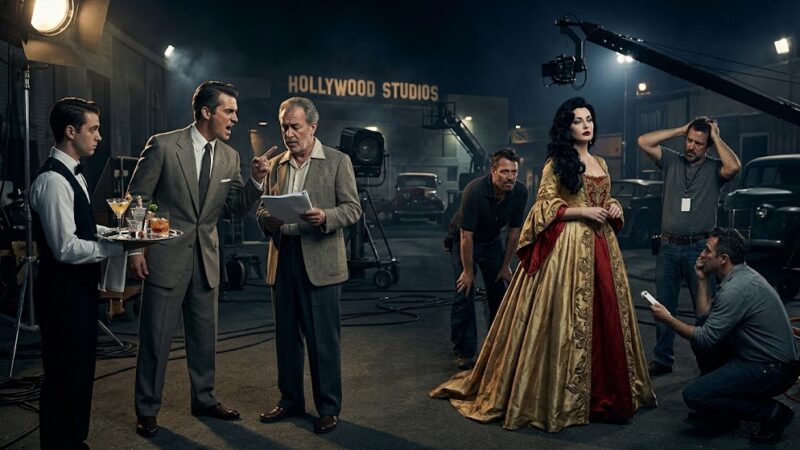
Hollywood’s Most Difficult Actors: When Talent Comes With a Price
Editorial note on sources and fairness: this article discusses different kinds of public reputation, not a verified ranking of professional misconduct. Documented production events should be distinguished from press anecdotes, artistic disagreements and subjective perceptions. Inclusion does not establish that every allegation about a performer is true, or that they are generally difficult to work with. Specific reporting is linked at the end.
When talent is only part of the equation
Hollywood loves difficult geniuses. For decades, the industry has romanticized the idea of the obsessive actor, the temperamental star and the performer willing to make everyone around them miserable in pursuit of one perfect scene. Sometimes that reputation comes from extraordinary commitment. Sometimes it comes from ego. And sometimes the stories surrounding an actor eventually become almost as famous as the performances themselves.
That distinction matters, because not everyone who appears on a list of supposedly difficult actors belongs there for the same reason. Some push directors creatively. Others become consumed by their characters. Some have dealt with very public personal problems, while a few simply seem to have developed reputations that follow them from production to production. None of that automatically makes someone a bad actor. In fact, several names on this list are among the most gifted performers of their generation.
📊 Quick View
🎬 Concept: Major Hollywood actors and actresses who have developed reputations for being difficult on set.
🧠 Focus: Where artistic intensity ends and problematic professional behavior begins.
⚡ Approach: A mix of industry reputation, public controversies and creative clashes.
⭐ Level: Oscar winners, blockbuster stars and some of the most recognizable performers in modern Hollywood.
🧩 Context: Being demanding or difficult does not automatically mean being unprofessional, and the reasons behind these reputations vary enormously.
Jared Leto and the danger of never leaving the character
Jared Leto may be one of the first names people think of when the conversation turns to extreme acting methods. Whatever anyone thinks about some of his more controversial roles, Leto has clearly shown that he can deliver strong performances when the material works. The debate has always been about everything surrounding those performances.
His reputation comes largely from a tendency to remain deeply immersed in a character beyond the moments when cameras are actually rolling. Method acting itself is hardly unusual in Hollywood, but there is a point where dedication to a role can start affecting the people around the performer. When that happens, the question becomes whether the process is still helping the movie or simply making the workplace uncomfortable.
Leto also has one of the strangest modern filmographies in Hollywood. Oscar-winning work sits alongside massively criticized blockbusters, creating the impression of an actor who is almost never boring but is frequently surrounded by controversy. Whether audiences love or hate the result, his projects tend to generate conversation.
Charlie Sheen: when personal chaos reaches the workplace
Charlie Sheen belongs to a very different category. His reputation was shaped less by artistic perfectionism than by years of highly publicized personal problems. At one point he was among the highest-paid television stars in America, yet his off-camera life eventually became inseparable from the work itself.
Stories involving substance abuse, erratic behavior and clashes with producers transformed Sheen from one of television’s most valuable performers into someone studios had to consider a genuine production risk. His career remains one of Hollywood’s clearest examples of what happens when enormous success and personal instability collide.
The irony is that Sheen could be extremely charismatic on screen. That charisma made him a star in the first place. But filmmaking and television production require reliability, and once that disappears, even enormous popularity may not be enough.
Sean Penn and an intensity that rarely switches off
Seeing Sean Penn on a list like this is not entirely surprising. He has built a career around intensity, both in the performances he chooses and in the way he approaches his work. Penn has never projected the image of an actor who simply arrives, hits his marks and goes home.
That seriousness has helped create some remarkable performances, but an uncompromising approach can also create friction. Actors who challenge decisions, question creative choices and demand changes may be invaluable to certain filmmakers and exhausting to others.
That is one of the recurring themes here: the exact same quality that makes an actor exceptional may also make that actor difficult. Penn’s intensity is clearly part of his artistic identity. Whether that becomes an advantage or a problem probably depends heavily on who is directing him.
Ezra Miller and a career overwhelmed by controversy
Ezra Miller represents a far more complicated situation. For a period of time, headlines surrounding Miller’s behavior away from movie sets became so frequent that they almost completely overshadowed the actor’s professional career.
For a studio, this creates a different kind of problem. Major franchises are enormous financial operations involving hundreds or even thousands of people. When one of the central performers becomes unpredictable, the risk extends far beyond whether a scene is difficult to shoot. Marketing, scheduling and the public image of an entire production can suddenly become affected.
Miller’s situation also demonstrated how difficult it can be for a studio to respond when a performer is already deeply embedded in a massive franchise. Once hundreds of millions of dollars have been invested, there are rarely simple solutions.
Shia LaBeouf: enormous potential buried under controversy
Shia LaBeouf may be one of the more frustrating cases because there was a period when his career appeared capable of going almost anywhere. Early movies like Disturbia showed exactly why Hollywood saw him as a potential major star. It remains a wonderfully entertaining thriller and one of those smaller movies that demonstrated his natural screen presence before the giant franchises arrived.
He eventually worked on enormous productions and alongside major filmmakers, but his public image became increasingly dominated by controversy. Over time, stories about confrontations, personal problems and difficult experiences surrounding different productions changed the way many people viewed him.
That is unfortunate because the talent never entirely disappeared. There is still something compelling about LaBeouf when he finds the right role. But Hollywood careers are not built exclusively on talent. Reliability and the ability to work inside a collaborative environment matter enormously, especially when millions of dollars are involved.
Joaquin Phoenix: perfectionism with consequences
Joaquin Phoenix is perhaps one of the most fascinating names on this list because his reputation is tied far more closely to artistic intensity than conventional celebrity scandal. Phoenix is known for approaching roles and projects with enormous seriousness, and that intensity can continue well into the development process.
He has also attracted attention for leaving projects relatively late in their development. From an actor’s perspective, walking away from something that no longer feels creatively right may seem perfectly reasonable. From the perspective of producers who have spent months building a film around that performer, the situation can become enormously disruptive.
But this is exactly why Phoenix complicates the conversation. Would anyone really want him to approach his work casually? The obsessive quality that may frustrate filmmakers is probably connected to the same instinct that has produced some of the best performances of his generation.
There is a difference between being careless and being almost excessively committed. Phoenix appears much closer to the second category.
Gwyneth Paltrow and Jennifer Lopez: the Hollywood diva problem
Gwyneth Paltrow and Jennifer Lopez have both spent years dealing with one of Hollywood’s oldest labels: the demanding diva. Stories surrounding unusual requests, particular working conditions and high expectations have followed both stars at different points in their careers.
However, this is also an area where some caution is necessary. Once a celebrity develops a reputation for being demanding, almost every story involving that person begins to reinforce the same narrative. A completely ordinary request can suddenly become evidence that someone is impossible to work with.
That does not mean every story should be dismissed. It simply demonstrates how powerful reputation becomes in Hollywood. Once an actor or actress is considered difficult, changing that perception can be almost as difficult as building a successful career in the first place.
Edward Norton: difficult, or simply too involved?
Edward Norton may be the most interesting case of all because his supposed difficulty seems directly connected to his desire to influence the movie beyond his own performance. Norton has long had a reputation for becoming deeply involved with scripts, editing and the overall construction of a film.
For some directors, that level of engagement may feel like collaborating with another filmmaker. For others, it may feel like having someone constantly crossing the traditional boundary between actor and director.
His history with the Hulk character is a perfect example of why Norton remains such an interesting figure in this conversation. His version of Bruce Banner existed in a darker, more aggressive movie than the direction Marvel eventually chose for the character. Creative differences ultimately helped push the franchise toward Mark Ruffalo and the larger tone of the Marvel Cinematic Universe.
And this is one case where the “difficult actor” label feels overly simple. Norton may absolutely become too involved. But the motivation appears to come from wanting a better or more specific movie rather than simply demanding special treatment.
Personally, it is difficult not to defend him a little. Norton is an exceptional actor, and his Hulk had a rawness and darkness that the later version of the character was never really designed to explore. Sometimes creative conflict is not evidence that somebody does not care. It can be evidence that two sides care very deeply about completely different versions of the same film.
Christian Bale and the pursuit of absolute control
Christian Bale has built an entire career around extreme commitment. Dramatic physical transformations, intense preparation and an almost obsessive attention to character have become part of his reputation as a performer.
But extreme concentration can also make a film set unforgiving. When an actor needs a particular environment to maintain that level of intensity, mistakes or interruptions may suddenly become much bigger issues than they would be for somebody with a more relaxed working style.
Bale therefore raises another uncomfortable question. How much difficult behavior do audiences and filmmakers excuse because the results are consistently impressive?
His performances make the debate particularly complicated because the commitment is visible on screen. Nobody can reasonably accuse Bale of not taking the work seriously. The issue is whether artistic seriousness should ever justify creating unnecessary tension for everyone else.
Russell Crowe and Mel Gibson: when temperament becomes part of the legend
Russell Crowe and Mel Gibson belong to a generation of stars whose strong personalities became part of their public identities. Both have been involved in highly publicized controversies over the years, and those stories inevitably changed the way audiences and the industry viewed them.
That creates another familiar dilemma for movie fans: separating the performer from the person. It is entirely possible to recognize a great performance while having little interest in defending the individual responsible for it.
Hollywood used to be particularly willing to overlook difficult personalities when those personalities belonged to profitable stars. The industry is less forgiving than it once was, but the basic equation still exists: the more valuable somebody is perceived to be, the more behavior people may be willing to tolerate.
Bill Murray and Tommy Lee Jones: veterans with little patience
Bill Murray is an especially interesting example because his public image has always contained two completely different versions of the same person. There is the charming, unpredictable comedy legend audiences adore, and then there are stories from productions describing a much more complicated personality.
Murray’s unpredictability is arguably part of his appeal as a performer. Unfortunately, unpredictability can be considerably less entertaining when people are trying to complete an expensive movie on schedule.
Tommy Lee Jones feels slightly different. His reputation is less about chaos and more about seriousness, impatience and extremely high standards. He has always projected the image of someone unlikely to tolerate unnecessary nonsense, and accounts from colleagues have sometimes reinforced that impression.
Neither situation necessarily makes someone a terrible colleague. But neither sounds like the easiest possible day at work either.
Miles Teller and a reputation that still has time to change
Miles Teller is one of the younger actors commonly included in this type of conversation. Stories about arrogance, creative disagreements and a particularly direct personality have followed him through different stages of his career.
But Teller also demonstrates why these reputations should never be treated as permanent verdicts. People change. Careers evolve. An actor who clashes with one director may develop an excellent relationship with another, and stressful productions can bring out the worst in almost anyone.
A pattern repeated across many sets is meaningful. A bad experience on a single movie is something completely different.
Does great art excuse a difficult artist?
The most interesting thing about these names is how little they actually have in common. Jared Leto is associated with extreme immersion. Joaquin Phoenix and Christian Bale are associated with extraordinary artistic intensity. Edward Norton wants influence over the finished movie. Other performers have been surrounded by personal controversies, volatile reputations or stories about extraordinary demands.
Putting all of them under the same label — “actors nobody wants to work with” — makes for a great headline, but reality is considerably more complicated.
There is also an uncomfortable tradition behind all of this. Hollywood has spent generations celebrating the myth of the difficult genius. If the performance was brilliant enough, almost anything could be dismissed as the price of greatness.
That idea deserves to be challenged. Movies are collaborative. The person whose face appears on the poster may receive the attention, but hundreds of other people are working behind that image. Talent should matter enormously. It should not automatically give anyone permission to make everybody else’s job miserable.
And perhaps that is the real question behind this entire list: how much would you be willing to tolerate from someone if you knew the final performance could be extraordinary?
Selected reporting behind specific examples: CBS News on the 2011 termination of Charlie Sheen’s contract; The Guardian on Joaquin Phoenix leaving a Todd Haynes production before filming; and CBS News on Bill Murray’s comments about the paused Being Mortal production. These reports concern specific incidents; they do not establish a uniform pattern for every performer discussed above.
Related reading: the corresponding Spanish editorial on difficult film productions.