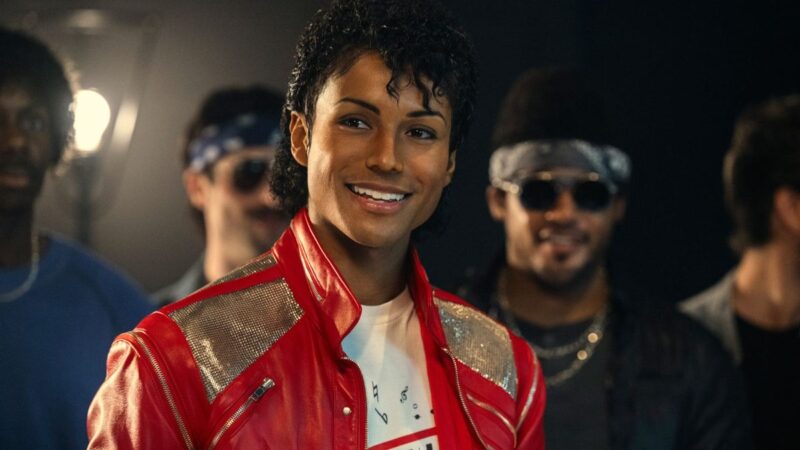
Michael: When a Great Tribute Refuses to Become a Great Biopic
The Modern Biopic Problem
Modern biopics often suffer from the same contradiction. They are marketed as stories about real people, yet many of them are ultimately designed as carefully controlled celebrations of their subjects. The more iconic the figure, the harder it becomes for filmmakers to explore the uncomfortable truths that helped shape that person’s legacy.
That is exactly where Michael finds itself. The film works extremely well as a celebration of Michael Jackson’s career, as a musical experience, and as a reminder of the enormous influence he had on popular culture. However, when it attempts to become a complete portrait of the man behind the legend, its limitations become impossible to ignore.
📊 Quick View
🎬 Concept: A musical biopic centered on the life and career of Michael Jackson.
🧠 Focus: Celebrating the artist rather than examining the person.
⚡ Approach: Emotional, accessible, and heavily controlled.
⭐ Level: Strong as entertainment, weaker as a complete biography.
🧩 Context: A production closely tied to Jackson’s legacy that avoids many of the most controversial chapters of his life.
A Life Too Large for Two Hours
The film faces a major challenge from the very beginning. Michael Jackson was not simply a successful singer. He was a cultural phenomenon who transformed music, performance, celebrity culture, and entertainment itself over several decades.
Trying to compress all of that into a little over two hours was always going to be difficult. The result is a narrative that rushes through key moments of his life without spending enough time exploring their significance. The audience is constantly moving from one milestone to another, often before those moments have had a chance to fully resonate.
The Jackson 5 years alone could have supported an entire film. The family dynamic, the pressure of fame, and the influence of his father played a critical role in shaping Michael Jackson as both an artist and a person. Yet much of that material feels abbreviated, reduced to highlights rather than explored in depth.
The Elephant in the Room
The most striking thing about Michael is not what it chooses to show, but what it chooses to avoid. The film consistently steers away from the most controversial aspects of Jackson’s life. Some issues are briefly acknowledged, others are merely hinted at, and some are absent altogether.
This is not about turning the movie into a courtroom drama or a character assassination. It is about recognizing that Michael Jackson’s story cannot be fully understood without addressing the events and controversies that defined much of the public conversation around him for decades.
The film touches on addiction in a superficial way. It references certain personal struggles without truly exploring them. It allows the audience to glimpse darker chapters but rarely stays long enough to examine them. Everything remains filtered through a protective lens that prevents the story from reaching the complexity it deserves.
What emerges is an extremely sanitized version of a figure whose contradictions are precisely what made him so fascinating to so many people.
When the Family Is Part of the Project
Perhaps the clearest explanation lies in the nature of the production itself. Michael is not an outside examination of the artist. It is a project that exists within the orbit of his legacy, and that inevitably shapes the narrative.
It is understandable that those closest to Jackson would want to protect his image. After all, he remains one of the most influential entertainers in history. The problem is that such protection often comes at the expense of honesty.
A truly great biopic should do more than explain why someone became famous. It should attempt to understand who they really were. Michael succeeds at the first task but struggles with the second.
Everything the Film Gets Right
Focusing exclusively on the film’s shortcomings would be unfair because there is a great deal that Michael does exceptionally well. The production values are impressive. The recreation of different eras, performances, and environments is often spectacular.
The music itself remains the film’s greatest weapon. Michael Jackson’s catalog is one of the most influential in modern history, and every major performance sequence serves as a reminder of why he became such a global phenomenon. The songs alone carry enormous emotional power.
The lead performance is also highly effective from a physical standpoint. There are moments when the illusion becomes remarkably convincing, capturing the movement, presence, and energy that made Jackson one of the most recognizable performers ever to step onto a stage.
Even when the film falls short as a complete character study, it remains a compelling celebration of his artistic achievements.
The Ongoing Problem with Musical Biopics
Michael is hardly alone in this regard. Many recent music biopics have followed a similar formula. They deliver impressive performances, polished visuals, and unforgettable music while softening or minimizing the most uncomfortable parts of their subjects’ lives.
Films such as Bohemian Rhapsody and A Complete Unknown have demonstrated that the industry is often far more comfortable celebrating icons than truly dissecting them. Some manage the balance better than others, but the tendency remains clear.
The strongest biopics are usually the ones willing to embrace contradiction. Acknowledging a person’s flaws does not diminish their achievements. In many cases, it helps explain them.
The Michael Jackson Story That Deserved More
The biggest issue with Michael may simply be its ambition. It attempts to cover childhood fame, family pressure, global superstardom, personal transformation, addiction, controversy, and cultural impact within a single film.
Those subjects are so significant that each could have supported an entire movie on its own. It is difficult not to imagine a larger project—perhaps even a trilogy—that could have explored these different chapters with the depth they deserved.
Instead, what audiences receive is a condensed version of an extraordinary life. Entertaining, emotional, and visually impressive, certainly. But also far too cautious to reach its full potential.
Final Verdict
Michael is a good film and a highly effective tribute to one of the most influential artists who ever lived. Musically it excels, visually it impresses, and it constantly reminds viewers of the enormous impact Michael Jackson had on the entertainment industry.
At the same time, it feels afraid to confront its subject head-on. It chooses celebration over examination and protection over exploration. In doing so, it misses the opportunity to become something truly exceptional.
The artist who transformed modern music deserved more than a collection of highlights. He deserved a film willing to embrace both his brilliance and his contradictions.
Related reading: the original Spanish review of Michael.
For another perspective on the musical biopic, read our ranking of Taron Egerton performances, which discusses how Rocketman approached the genre.