Why Streaming Needs One Hub: The Problem with Too Many Apps
The real problem with streaming isn’t content
For years, the conversation around streaming has focused on one thing: more. More platforms, more shows, more movies. But the reality is much simpler — and far more frustrating. The issue isn’t a lack of content. It’s how that content is scattered.
Having multiple subscriptions sounds great on paper, but in practice it turns into friction. You want to watch something, but first you need to remember where it lives. Then you jump between apps, adapt to different interfaces, and repeat the process every time.
That’s where the idea of a hub comes in. Not as a luxury feature, but as a necessary evolution of the entire streaming experience.
📊 Quick View
🎬 Concept: A unified platform for multiple streaming services
🧠 Focus: User experience and content accessibility
⚡ Approach: Practical and industry-driven analysis
⭐ Level: High impact on daily usability
🧩 Context: Fragmented streaming ecosystem
What a hub actually means for the user
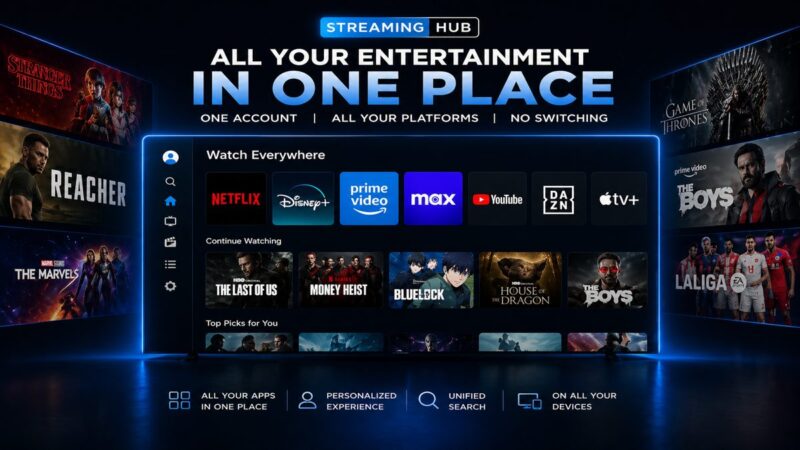
A hub isn’t just a place where content is grouped together. It’s a system that removes decision fatigue. It allows you to stop thinking about platforms and start focusing purely on what you want to watch.
The shift is subtle but powerful. Instead of asking “which service is this on?”, you simply search, click, and play. No switching. No second guessing. No interruptions.
When that barrier disappears, the entire experience becomes smoother — almost invisible. And that’s exactly the point.
Why unified interfaces matter more than design
One of the most underrated aspects of a hub is consistency. Most streaming platforms invest heavily in their own design language, but from a user perspective, that variety becomes noise.
Every platform behaves differently. Navigation changes. Information is presented in different ways. Even something as simple as continuing a show can feel inconsistent.
A hub fixes that. It standardizes the experience. Same layout, same logic, same interaction — regardless of where the content originally comes from.
And once you get used to that level of consistency, going back feels unnecessarily complicated.
The biggest advantage: friction disappears
The real value of a hub is not the number of services it includes, but how seamlessly it presents them.
Search becomes universal. Discovery becomes faster. And most importantly, watching becomes immediate.
You don’t think about platforms anymore. You don’t navigate ecosystems. You simply consume content.
That shift turns streaming from a fragmented experience into something fluid — almost effortless.
Where the model falls short
As strong as the concept is, it’s far from perfect. The biggest limitation is control. Most hub systems don’t allow users to integrate their own existing subscriptions.
Instead of being a neutral space, the hub becomes another layer of ownership. You access services through it, but not necessarily on your own terms.
This creates a disconnect. The idea promises freedom, but the execution often comes with restrictions.
And that tension is hard to ignore.
Why major platforms resist integration
Not every company benefits from being part of a hub. In fact, the biggest players have strong reasons to stay independent.
Streaming platforms don’t just host content — they control discovery. Recommendations, trends, featured titles… all of it shapes what users watch.
Giving that control away means losing influence. And for dominant platforms, that’s not a trade worth making.
So instead of integration, they double down on their own ecosystems.
The model that should exist
The ideal version of a hub would be user-driven. A place where you connect your subscriptions, manage them freely, and access everything without limitations.
Open, flexible, and platform-agnostic.
But that model requires cooperation between competitors. And in an industry built on exclusivity, that’s where things break down.
What makes sense for the user doesn’t always align with business strategy.
Final thoughts: the direction is clear
Even with its limitations, the hub concept feels like the natural evolution of streaming.
It solves a problem that keeps getting worse: fragmentation. And once you experience a unified system, it’s hard to go back.
The industry may not be fully ready to embrace it, but the demand is already there.
Because in the end, users don’t want more platforms. They want a better way to use them.
For the viewing experience beyond the platforms themselves, see our analysis of what works and what disappoints in streaming series.